The emergence of vibe coding has created a new question for anyone wanting to build software: should I use AI-assisted natural language development, hire traditional developers, or try some combination? The answer depends on what you are building, your resources, and your goals.
This guide provides a framework for making that decision. We will define both approaches, compare their strengths and weaknesses, identify the best use cases for each, and explore how they can work together.
Defining the Two Approaches
What is Vibe Coding?
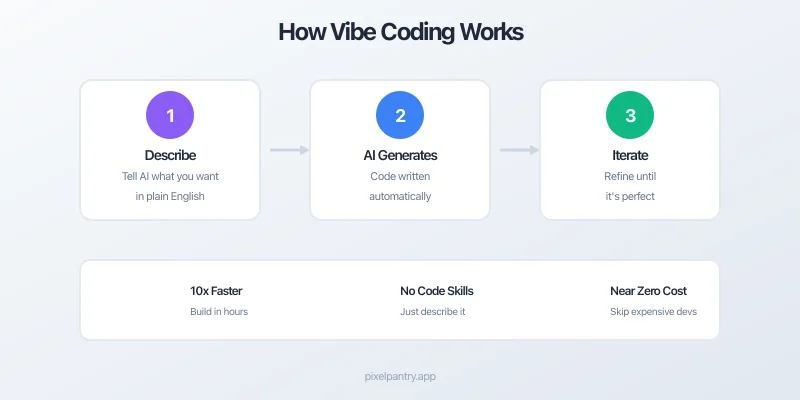
Vibe coding is the practice of building software by describing what you want in natural language to an AI assistant. Instead of writing code directly, you have a conversation: you explain your requirements, the AI generates code, you test it, provide feedback, and iterate until the software works as intended.
The key characteristics of vibe coding:
- No programming language knowledge required
- Conversational, iterative process
- AI handles implementation details
- Fast for straightforward requirements
- Lower barrier to entry
What is Traditional Development?
Traditional development involves human programmers writing code directly. Developers learn programming languages, understand computer science concepts, and translate requirements into working software through manual coding. This approach has been the standard for decades.
The key characteristics of traditional development:
- Requires programming expertise
- Structured methodologies and processes
- Deep understanding of how code works
- Established tools and practices
- Higher initial investment, broader capabilities
Note: Modern traditional development often incorporates AI tools for assistance, but the human developer remains the primary decision-maker and code author.
Comparing Strengths and Weaknesses
Vibe Coding Advantages
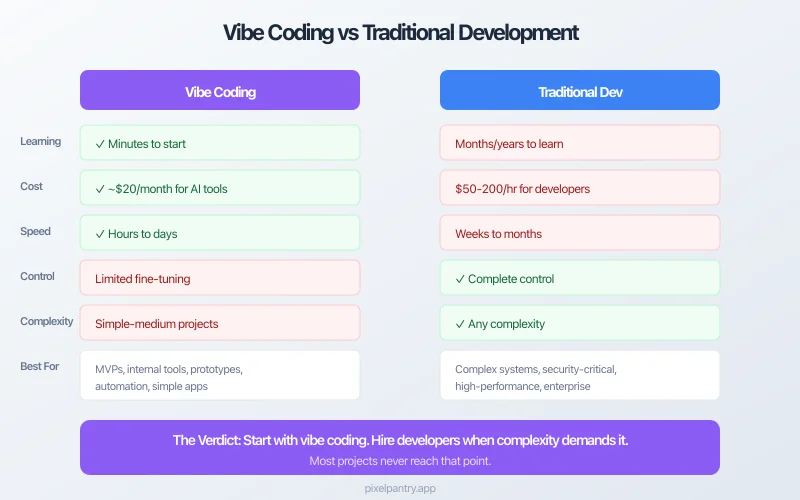
Accessibility: Anyone can create software without years of technical training. Business owners, marketers, and domain experts can build tools directly.
Speed for simple projects: Getting from idea to working prototype can happen in hours instead of weeks. The feedback loop is incredibly fast.
Low cost: AI assistant subscriptions cost $0-20/month compared to $100-250/hour for professional developers. For small projects, the economics are dramatically different.
Domain expert empowerment: The person who best understands the problem can build the solution directly, without translation through developers who may not understand the business context.
Experimentation friendly: Try ideas quickly without significant investment. If something does not work, you have not lost much.
Vibe Coding Limitations
Complexity ceiling: As projects grow more complex, vibe coding struggles. AI can lose context, generate inconsistent code, or fail to understand nuanced requirements.
Quality uncertainty: Without programming knowledge, it is hard to evaluate whether generated code is well-structured, secure, or maintainable.
Debugging challenges: When things go wrong, diagnosing and fixing issues requires understanding the code, which vibe coders may lack.
Limited optimization: AI-generated code may work but not be efficient. For performance-critical applications, this matters.
Traditional Development Advantages
Handles complexity: Skilled developers can build arbitrarily complex systems with sophisticated architectures, optimizations, and integrations.
Quality control: Professional developers understand code quality, security practices, and maintainability. They can build systems meant to last.
Performance optimization: When speed and efficiency matter, experienced developers can optimize at levels AI cannot match.
Deep debugging: Developers can trace through code, understand exactly what is happening, and fix subtle issues that would baffle AI.
Architectural decisions: For systems that need to scale, integrate with many services, or evolve over years, architectural expertise is essential.
Traditional Development Limitations
Cost: Good developers are expensive. Simple projects that take a developer days might not justify the investment.
Timeline: Even with modern tools, traditional development takes time. Requirements gathering, design, development, testing, and deployment add up.
Communication overhead: Explaining your needs to developers introduces translation loss. They may build exactly what you asked for but not what you actually needed.
Availability: Finding good developers is hard. They are in high demand and may not be available when you need them.
When to Use Vibe Coding
Vibe coding excels in specific scenarios:
Personal Tools and Automations
Building tools just for yourself or your small team is ideal for vibe coding. The stakes are lower, requirements are clear in your head, and iteration is easy. Expense trackers, data converters, simple dashboards, and workflow automations all fit well.
Prototypes and Proofs of Concept
Before investing in full development, vibe coding can validate ideas. Build a rough version to test whether the concept works, get user feedback, and refine requirements. If the idea has legs, hand off to traditional development with much clearer specifications.
Simple Customer-Facing Tools
Basic calculators, forms, quizzes, and interactive content can be vibe coded effectively. These have limited complexity and clear requirements that AI handles well.
Learning and Exploration
Want to understand what is possible? Vibe coding lets you explore without committing to learning programming. You build understanding of software capabilities and limitations through direct experience.
Budget-Constrained Projects
When you simply cannot afford traditional development, vibe coding provides an alternative. Something that works imperfectly may still be better than nothing.
When You Need Traditional Development
Some projects require professional developers:
Systems That Handle Sensitive Data
Payment processing, healthcare information, financial data, and personal information require security expertise. AI-generated code may have vulnerabilities that only trained eyes catch. The consequences of security failures justify professional development.
Applications Requiring Scale
If your application needs to serve thousands or millions of users reliably, architectural decisions matter. Database design, caching strategies, load handling, and infrastructure choices require expertise.
Complex Business Logic
When your software must handle many edge cases, complex rules, and sophisticated workflows, traditional development provides the control needed. ERP systems, complex scheduling, and multi-step business processes typically need professional attention.
Long-Term Maintainability
Software meant to run and evolve over years needs to be built with maintainability in mind. Clean architecture, documentation, testing, and consistent patterns matter for long-term health.
Integration with Complex Systems
Connecting to legacy systems, multiple APIs, or enterprise infrastructure often requires deep technical knowledge and debugging capabilities that vibe coding cannot provide.
Regulated Industries
Healthcare, finance, government, and other regulated sectors may require documentation, audit trails, and specific compliance measures that demand professional development practices.
The Hybrid Approach
The most powerful strategy often combines both approaches. Here is how:
Vibe Code the Prototype, Professionally Develop the Product
Use vibe coding to quickly test ideas and nail down requirements. Once you know what you want, engage developers with a clear, tested specification. This reduces waste and improves communication.
Professional Core, Vibe-Coded Extensions
Have developers build the critical, complex core of your system. Use vibe coding to create peripheral tools, reports, and utilities that connect to but do not compromise the core.
Developer Review of Vibe-Coded Work
Build with vibe coding, then pay a developer for a few hours of review. They can identify security issues, suggest improvements, and validate that the code is safe to use. Much cheaper than full development but provides quality assurance.
AI-Assisted Professional Development
Professional developers increasingly use AI tools to accelerate their work. This is not vibe coding, it is traditional development enhanced by AI. When hiring developers, those using modern tools effectively will deliver faster and potentially at lower cost.
Gradual Professionalization
Start with vibe coding for an MVP. As the project proves valuable and grows, gradually rebuild critical components with traditional development. This matches investment to proven value.
Decision Framework
Use these questions to guide your choice:
How complex is the project? Simple (single-purpose tools) favors vibe coding. Complex (many features, integrations, edge cases) favors traditional.
What is at stake if it fails? Low stakes (personal tools, experiments) suit vibe coding. High stakes (financial, reputational, safety) require professional attention.
What is your budget? Under $5,000 often means vibe coding or no-code platforms. Over $20,000 opens traditional development options.
How long does this need to last? Temporary or short-term needs can be vibe coded. Long-term systems benefit from professional development.
Who will maintain this? If you will maintain it yourself and are comfortable with AI tools, vibe coding works. If others will maintain it, professional standards matter more.
How specialized is the domain? If you understand the problem better than any developer could, vibe coding lets you apply that knowledge directly.
Real-World Examples
To make this concrete, here are example projects and recommended approaches:
Client Intake Form That Sends Data to Your CRM
Recommended: Vibe coding for the form, possibly with developer review of the API integration. Simple enough for AI, but the integration deserves a sanity check.
E-commerce Website with Payment Processing
Recommended: Traditional development or established platforms. Payment handling requires security expertise and compliance considerations.
Internal Dashboard Showing Business Metrics
Recommended: Vibe coding if it is read-only from existing data sources. The main user is internal, stakes are lower, and requirements are clear.
Customer-Facing Mobile App
Recommended: Traditional development. App store requirements, multiple platforms, user experience expectations, and public scrutiny warrant professional quality.
Prototype for Investor Presentation
Recommended: Vibe coding. Speed matters, it just needs to demonstrate the concept, and you can rebuild properly after funding.
Healthcare Records System
Recommended: Traditional development with compliance expertise. Regulatory requirements, security needs, and liability concerns demand professional attention.
The Future of This Divide
The line between vibe coding and traditional development is blurring and will continue to do so. AI capabilities improve constantly. What required professional development today may be vibe-codeable next year.
At the same time, the most complex, critical, and novel projects will continue to need human expertise. The ceiling rises, but there is always a ceiling.
The winning strategy is flexibility. Learn to use vibe coding for appropriate projects. Know when to bring in professionals. Combine approaches where it makes sense. As tools evolve, stay current on what is possible.
At Pixel Pantry, we use both approaches. Some of our free tools started as vibe coding experiments. Others required traditional development expertise. The result is tools that genuinely help business owners, built efficiently with the right approach for each challenge.