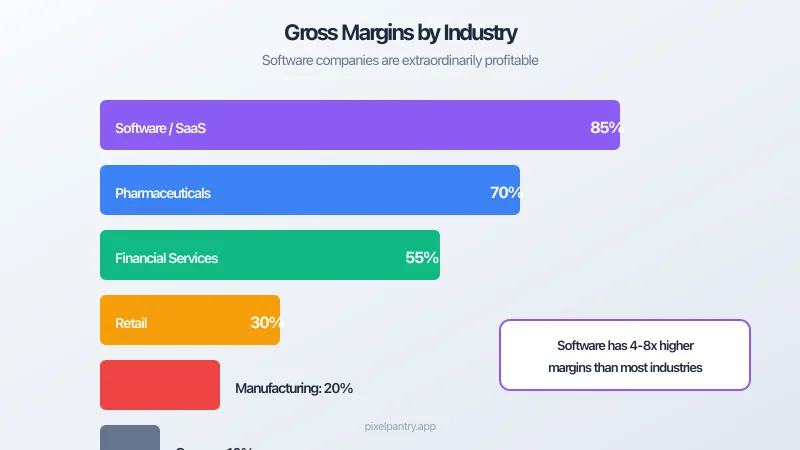
If you've ever wondered why tech giants like Microsoft, Adobe, and Salesforce seem to print money while traditional businesses struggle with razor-thin margins, you're not alone. The secret lies in the unique economics of software, where gross margins regularly exceed 80% - a figure that would make executives in most other industries weep with envy.
In this article, we'll break down exactly how tech companies achieve these impressive margins, compare them to traditional industries, and explore what this means for you as a consumer and potential entrepreneur.
What Are Gross Margins, and Why Do They Matter?
Before diving into the numbers, let's clarify what we mean by gross margin. Simply put, gross margin is the percentage of revenue that remains after subtracting the direct costs of producing a product or service. The formula is straightforward:
Gross Margin = (Revenue - Cost of Goods Sold) / Revenue x 100
The 80-90% Gross Margin Reality in Software
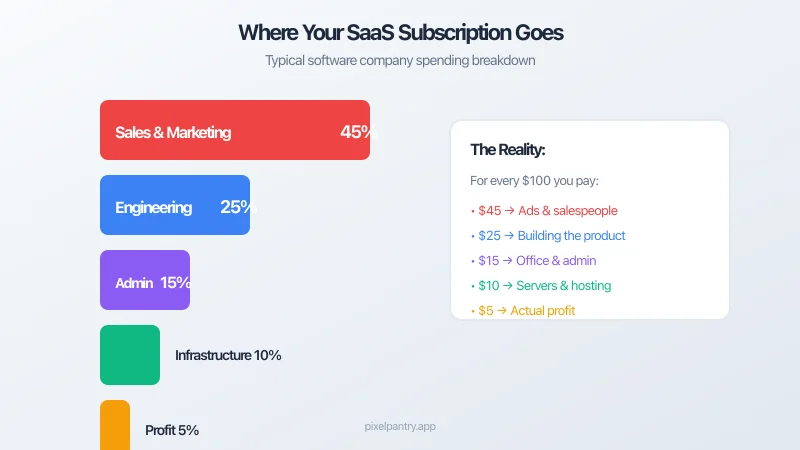
Software companies routinely achieve gross margins between 80% and 90%. Here's what that looks like in practice:
- Microsoft: 69% overall gross margin, but cloud services exceed 70%
- Adobe: 88% gross margin on subscription software
- Salesforce: 73% gross margin
- Atlassian: 83% gross margin
- Zoom: 79% gross margin
These numbers are extraordinary. For every dollar these companies collect in revenue, they keep 70-90 cents before accounting for sales, marketing, research, and administrative costs.
Why This Matters for Consumers
Understanding software economics helps explain several things consumers experience:
Why Free Tiers Exist
The low marginal cost means companies can afford to give away basic versions for free, hoping some users convert to paid plans. At Pixel Pantry, we take this further - our tools like Caroline are completely free because we believe useful software shouldn't come with a monthly bill.
The Bottom Line
Software companies enjoy extraordinarily high gross margins because their products cost almost nothing to reproduce and distribute. While these margins don't guarantee profitability (many tech companies lose money despite 80%+ gross margins), they do explain why software has become such an attractive industry for entrepreneurs and investors alike.
At Pixel Pantry, we've built our business on the idea that essential productivity tools should be free. High margins mean we can operate sustainably while keeping our tools accessible to everyone - no subscription required.