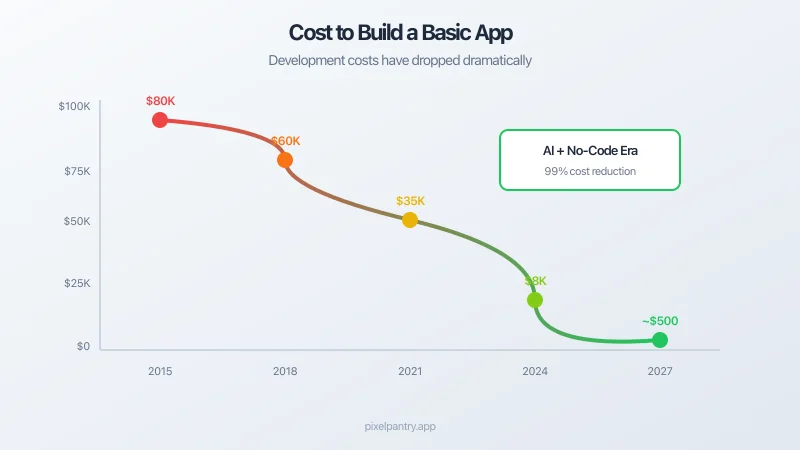
If you asked for a custom software quote five years ago, the numbers probably made you wince. A simple mobile app might run $50,000 to $150,000. A custom business application could easily exceed $200,000. For most small businesses, custom software was simply not an option.
That equation has fundamentally changed. The same projects that cost six figures in 2020 can now be built for a fraction of that price, and the trend is accelerating. Understanding why helps business owners recognize opportunities and make smarter technology decisions.
The Historical Cost of Software Development
To appreciate how much has changed, we need to understand what drove software costs in the past.
The Expensive Ingredients
Developer time: Skilled programmers commanded high hourly rates ($100-250/hour for agencies), and projects required many hours. A simple app might need 500-2000 hours of development time.
Infrastructure: Running software required servers, which meant either buying hardware or paying substantial monthly hosting fees. Scaling to handle more users required buying more capacity upfront.
Tooling and licenses: Development tools, databases, and software libraries often required expensive licenses. Enterprise software stacks could cost tens of thousands annually.
Ongoing maintenance: Software requires updates, bug fixes, and security patches. Maintenance contracts typically ran 15-25% of the original development cost annually.
The 2020 Reality
Consider what building a custom CRM system would have cost around 2020:
- Requirements and design: $15,000-30,000
- Development (800-1200 hours): $80,000-180,000
- Testing and deployment: $10,000-25,000
- First year hosting and maintenance: $20,000-40,000
Total: $125,000-275,000 for year one
These numbers put custom software out of reach for most small businesses. The alternative was adapting to off-the-shelf solutions that never quite fit.
What Changed: The Triple Revolution
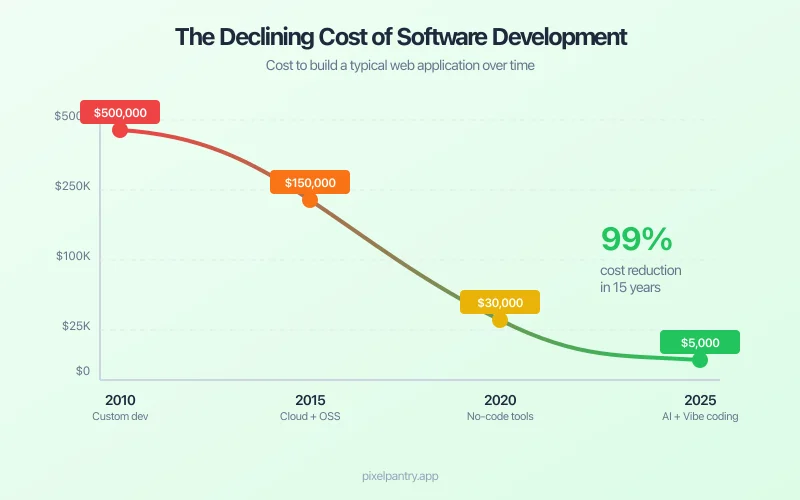
Three major shifts have combined to slash software development costs:
1. AI Coding Assistants
This is the biggest factor. AI coding tools have transformed developer productivity in ways that seemed impossible just a few years ago.
Tasks that once took hours now take minutes. Writing boilerplate code, implementing common patterns, debugging issues, and generating documentation can all be accelerated dramatically with AI assistance.
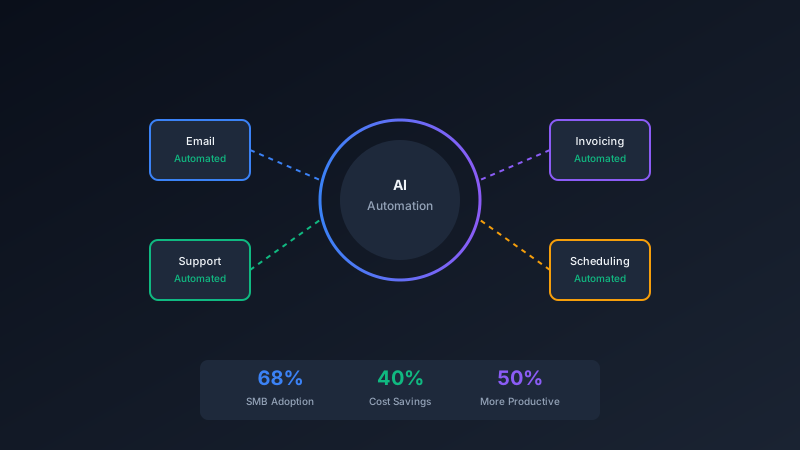
Studies and industry reports suggest productivity gains of 30-50% for experienced developers using AI tools. For certain types of projects, the gains are even higher. This directly translates to lower costs.
More importantly, AI enables non-developers to create software through vibe coding. Business owners can build simple tools themselves, eliminating developer costs entirely for appropriate projects.
2. Cloud Infrastructure Economics
Cloud computing has transformed from premium service to commodity. Key changes include:
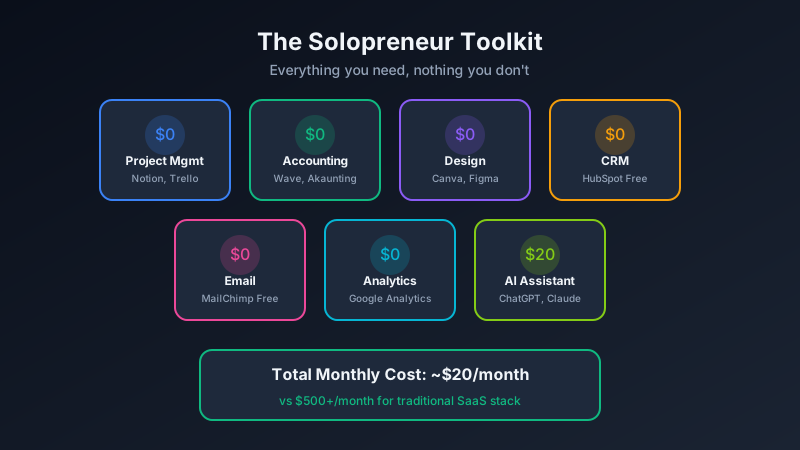
Serverless computing: Pay only for actual usage, not idle capacity. A small business application might cost $5-20/month to run instead of hundreds for dedicated servers.
Managed services: Databases, authentication, file storage, and other components are available as services. No need to build or maintain these yourself.
Price competition: Amazon, Google, Microsoft, and newer providers compete aggressively, continuously lowering prices.
The result: infrastructure that would have cost $2,000/month in 2015 might cost $50/month today for equivalent capability.
3. Open Source Maturity
The open source ecosystem has matured to a point where high-quality, free components exist for nearly every common software need:
- Complete web frameworks (React, Vue, Django, Rails)
- Databases (PostgreSQL, MySQL, MongoDB)
- Authentication systems (Auth0 free tier, Firebase Auth)
- UI component libraries (Material UI, Tailwind CSS)
- Payment processing (Stripe, which is free until you process payments)
Instead of building everything from scratch, developers assemble applications from proven components. This reduces both development time and risk.
2020 vs. 2025: Real Cost Comparisons
Let us revisit that custom CRM system with 2025 approaches:
Traditional Development with AI Assistance
Using a development agency that leverages AI tools:
- Requirements and design: $5,000-12,000
- Development (300-500 hours with AI): $30,000-75,000
- Testing and deployment: $5,000-15,000
- First year cloud hosting: $500-2,000
Total: $40,500-104,000 for year one
That is roughly 50-60% less than 2020 costs for equivalent functionality.
Low-Code/No-Code Approach
Using platforms designed for building business applications:
- Platform subscription: $1,200-6,000/year
- Configuration and customization: $10,000-30,000
- Training and documentation: $2,000-5,000
Total: $13,200-41,000 for year one
AI-Assisted DIY (Vibe Coding)
For a technically curious business owner with time to learn:
- AI assistant subscription: $0-240/year
- Cloud hosting: $0-500/year
- Your time (significant but has secondary value as learning)
Total: $0-740 in direct costs
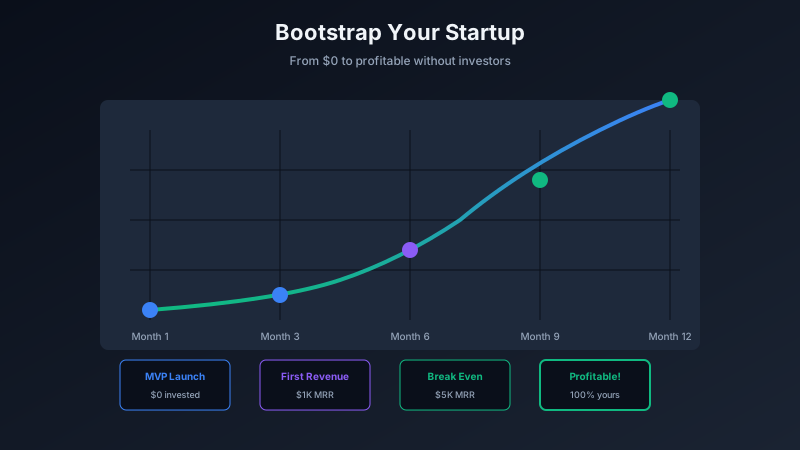
The DIY approach is not for everyone or every project, but the fact that it is possible at all represents a dramatic change.
What This Means for Business Owners
The implications of falling software costs extend beyond just saving money:
Custom Solutions Become Viable
Problems that were not worth solving with custom software are now economical to address. That workflow inefficiency costing you a few hours per week? Worth automating when the solution costs hundreds instead of tens of thousands.
At Pixel Pantry, we can create and offer free tools precisely because development costs have dropped so dramatically. What would have required substantial investment now requires primarily time and expertise.
Experimentation Becomes Affordable
When software is expensive, you only build what you are certain you need. When costs drop, you can afford to experiment. Try building that tool you are unsure about. If it does not work out, you have not lost much.
Competitive Advantages Democratize
Large companies used to have insurmountable technology advantages because they could afford custom development. That gap is narrowing. Small businesses can now afford sophisticated tools that were previously enterprise-only.
Software Becomes Disposable
When software is expensive, you maintain it forever, patching and extending regardless of how outdated it becomes. When software is cheap, you can rebuild when requirements change significantly. This leads to better-fitted solutions over time.
The Future: Even Lower Costs Ahead
Current cost reductions are just the beginning. Trends suggest continued decline:
AI capabilities are improving rapidly. Each generation of AI models handles more complex tasks with less human oversight.
Development tools are integrating AI more deeply. The gap between describing what you want and having working software continues to shrink.
Component ecosystems keep expanding. More pre-built, tested components mean less custom code to write.
For business owners, this means the best time to build custom software may be now, or it may be worth waiting a bit longer if your needs are not urgent. Either way, the era of software being prohibitively expensive for small businesses is ending.
At Pixel Pantry, we are excited about what this means for the entrepreneurs and small business owners we serve. The tools that help you run your business better are becoming more accessible every day, and we are committed to being part of that transformation.