Here's a statistic that surprises most people: Salesforce, one of the world's most successful software companies, spends nearly twice as much on sales and marketing as it does on research and development. They're not alone. Across the tech industry, companies routinely invest more in convincing you to buy their products than in building those products in the first place.
This isn't a sign of corporate dysfunction - it's a rational response to the economics of modern software. But understanding this dynamic can help you make smarter decisions about the tools you use and, if you're an entrepreneur, how you build your own business.
The Numbers: Where Big Tech Actually Spends Its Money
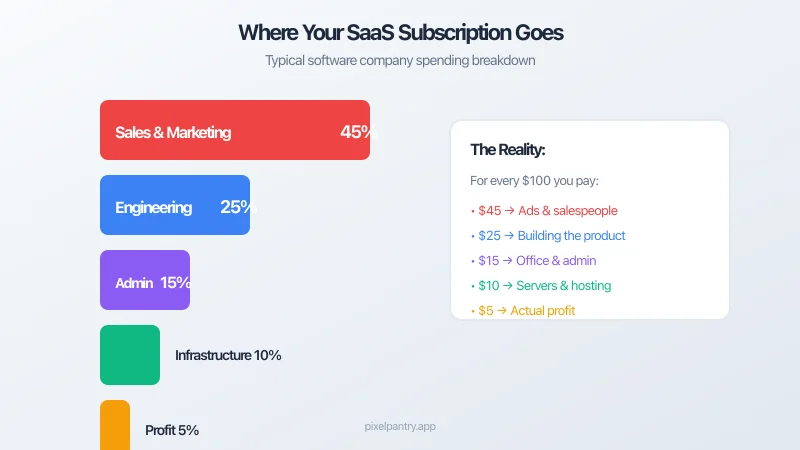
Let's look at the actual spending breakdowns for some major tech companies (based on their most recent annual reports):
Salesforce
- Sales & Marketing: 45% of revenue
- Research & Development: 17% of revenue
- Ratio: 2.6x more on sales than engineering
ServiceNow
- Sales & Marketing: 40% of revenue
- Research & Development: 23% of revenue
- Ratio: 1.7x more on sales than engineering
HubSpot
- Sales & Marketing: 47% of revenue
- Research & Development: 22% of revenue
- Ratio: 2.1x more on sales than engineering
The pattern is clear: enterprise software companies consistently allocate more budget to sales and marketing than to the engineers who build the actual product. But why?
The Word-of-Mouth Alternative
The companies that spend less on sales share a common trait: they've built products good enough that users do the marketing for them. This word-of-mouth growth model has several advantages:
Lower CAC
When users recommend your product, you don't pay for that acquisition. Viral growth compounds over time while paid acquisition costs only grow.
Better Customers
Customers who find you through recommendations tend to be more loyal, less price-sensitive, and more forgiving of issues. They came because a trusted person vouched for you.
The Pixel Pantry Approach
At Pixel Pantry, we've embraced the word-of-mouth model from day one. Our tools like Caroline are completely free - not freemium, not trials, actually free. We have no sales team, no advertising budget, and no pressure to convert users into paying customers.
This lets us focus 100% on building great software. Every hour we spend goes into making our tools better, not into convincing you to buy something. When you use a Pixel Pantry tool, you can be confident it exists because we thought it would be useful, not because we thought we could sell it.
We believe this is how software should work. Build something genuinely helpful, give it away, and let satisfied users spread the word. It's not the fastest path to growth, but it's the most honest one.
The Bottom Line
The fact that tech giants spend more on sales than engineering isn't inherently good or bad - it's a reflection of how competitive the software market has become. But it does create opportunities for companies willing to take a different path.
Products that grow through word-of-mouth tend to be better products. They have to be - there's no sales team to paper over shortcomings. If you're evaluating software or building your own product, remember: the best marketing is a product so good that users can't help but tell others about it.