Something remarkable is happening in the software industry. High-quality tools that would have cost hundreds or thousands of dollars a decade ago are now available for free. From design software to project management, from AI assistants to complete development environments, the price tag on powerful software is increasingly zero.
This is not a bubble waiting to burst. It is the result of fundamental shifts in technology, economics, and philosophy that have been building for decades. Understanding why software is becoming free helps you take advantage of this trend and make smarter decisions about the tools you use.
A Brief History of Free Software
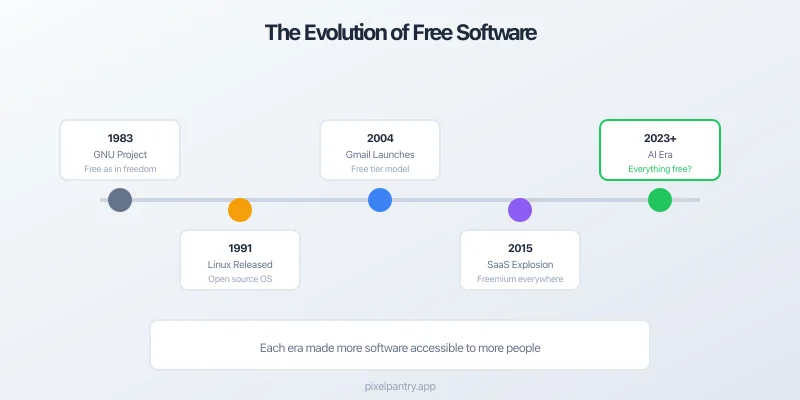
The free software movement did not start with the internet or even personal computers. Its philosophical roots trace back to the earliest days of computing, when sharing code was simply how things were done. Programmers at universities and research labs freely exchanged their work, building on each other's contributions.
The Open Source Foundation
In 1983, Richard Stallman launched the GNU Project with a radical proposition: software should be free for anyone to use, study, modify, and distribute. This was not about price but about freedom. The Free Software Foundation codified these principles, and the GNU General Public License became a legal framework for ensuring software remained open.
When Linus Torvalds released Linux in 1991, he demonstrated that a community of volunteers could build software rivaling corporate products. Linux became the foundation for Android, powers most web servers, and runs everything from supercomputers to smart refrigerators. This was proof that free software could compete at the highest levels.
The Rise of Freemium
The 2000s introduced a new model: freemium. Companies like Dropbox, Slack, and countless others discovered that giving away a useful free tier attracted users who might eventually pay for premium features. The free version was not charity but marketing.
This model worked because software has a unique economic property: once created, the cost of serving an additional user is often negligible. Unlike physical products, there is no manufacturing cost per unit. This makes free tiers economically viable in ways impossible for traditional goods.
Why Free Software is Exploding in 2025
Several converging factors are accelerating the trend toward free software right now:
AI Dramatically Reduces Development Costs
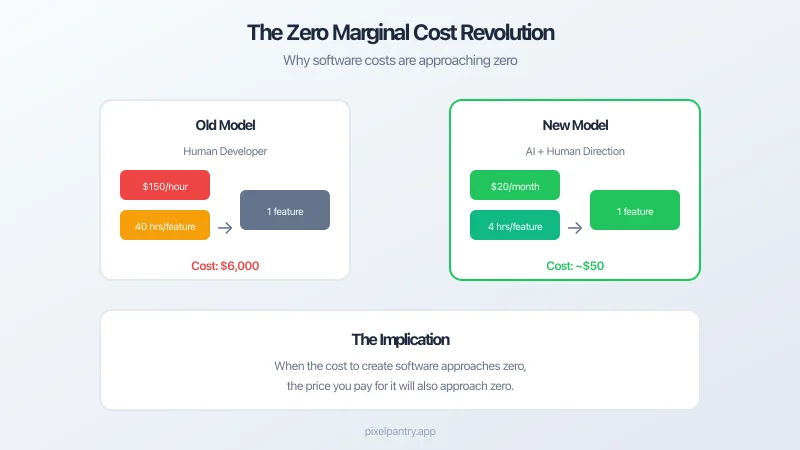
The elephant in the room is artificial intelligence. AI coding assistants have slashed the time and cost required to build software. Tasks that once required days of developer time now take hours. This means smaller teams can build more ambitious projects, and individuals can create tools that previously required entire companies.
At Pixel Pantry, we have experienced this directly. AI allows us to create and maintain free tools that would have been economically impossible just a few years ago. We can focus on solving real problems for business owners without the overhead that traditionally made software expensive.
Cloud Infrastructure Costs Continue Falling
Running software used to require owning servers, hiring system administrators, and managing complex infrastructure. Cloud platforms have made this a variable cost that scales with usage. A small app serving a few hundred users costs almost nothing to host.
Competition among cloud providers continues driving prices down. What cost dollars per hour a decade ago now costs pennies. This makes free tiers sustainable for more types of software.
Open Source Components Are Better Than Ever
Modern software is built from components, and most of those components are open source. Authentication, payment processing, database management, user interfaces these are all available as high-quality open source libraries. Developers no longer need to build everything from scratch.
This dramatically reduces the effort required to create new software. If 90% of your application uses existing open source components, you only need to build and maintain the 10% that makes your product unique. The economics of free become much more attractive.
The Economics Behind Sustainable Free Software
Understanding how free software sustains itself helps you evaluate which free tools are likely to remain available and trustworthy:
Open Source Community Development
Projects like Linux, Firefox, and WordPress are maintained by communities of volunteers and companies that depend on these tools. Contributors gain reputation, learning opportunities, and the satisfaction of creating something useful. Companies contribute because they benefit from improvements.
Freemium Conversion
Many free tools are loss leaders for paid products. The company bets that a percentage of free users will upgrade to paid tiers with more features, storage, or support. The free tier is sustainable because it feeds the paid business.
Donation-Supported Tools
Some creators, like us at Pixel Pantry, make software free and invite users to donate if they find value. This model works when the tools are genuinely useful and users want to support continued development.
Our Place in the Free Software Movement
At Pixel Pantry, we create free tools because we believe useful software should be accessible to everyone, especially small business owners and entrepreneurs who are trying to build something meaningful without enterprise budgets.
We sustain ourselves through optional donations from users who find value in what we create. This model keeps us aligned with our users rather than advertisers or data brokers. When someone donates to Pixel Pantry, they are not buying software; they are supporting a mission they believe in.
The free software movement has always been about more than price. It is about freedom, access, and the belief that technology should empower everyone. In 2025, that vision is more achievable than ever.