For decades, the build vs buy decision was straightforward for most businesses: buy. Custom software was expensive, time-consuming, and risky. Off-the-shelf solutions, while imperfect, were the sensible choice for all but the largest enterprises.
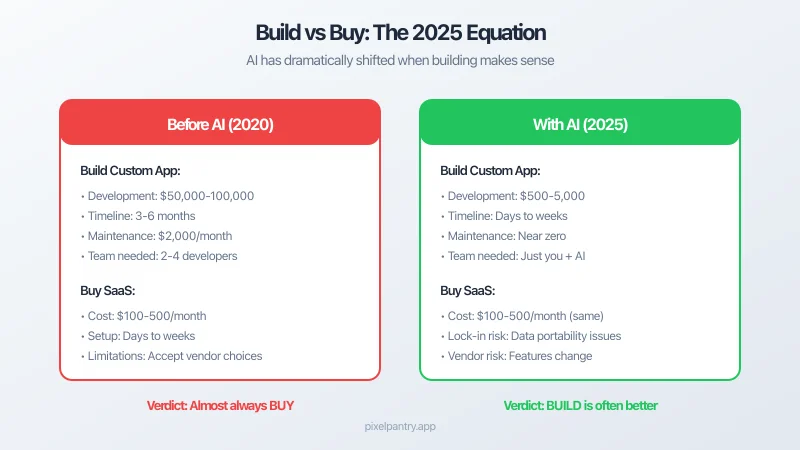
That calculation is changing rapidly. AI-assisted development has dramatically reduced the cost and time to build custom software. The equation that once strongly favored buying is now much more balanced, and in many cases, tips toward building.
Let us examine how to think about this decision in 2025.
The Traditional Build vs Buy Framework
Before diving into what has changed, let us establish the traditional framework for this decision.
Arguments for Buying
Lower upfront cost: Off-the-shelf software requires no development investment. You pay a subscription and start using it immediately.
Faster deployment: Commercial software is ready now. Building takes months or years.
Ongoing maintenance included: The vendor handles updates, security patches, and new features.
Arguments for Building
Perfect fit: Custom software can match your exact requirements.
Competitive advantage: Unique capabilities that competitors cannot easily replicate.
Control: You own the code and can modify it as needed.
How AI Changes the Equation
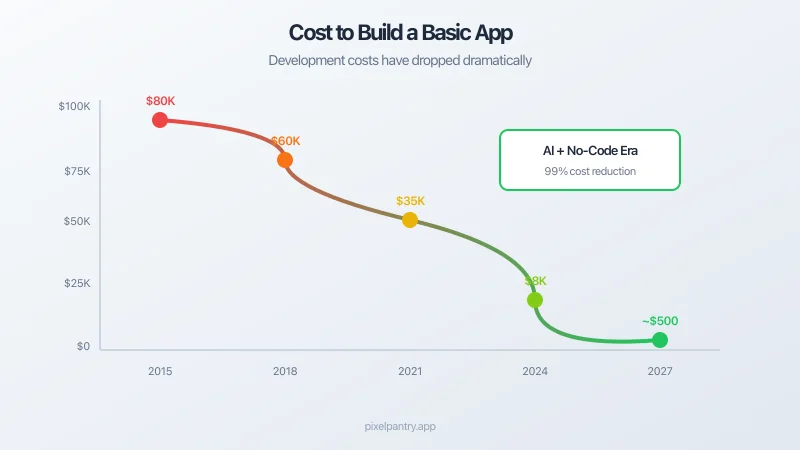
AI-assisted development has fundamentally altered the cost and time variables in this calculation.
Development Cost Reduction
AI coding assistants have reduced development time by 30-50% for experienced developers, and even more for certain tasks. This translates directly to cost reduction.
The Trend Is Clear
The economics of software development continue shifting toward building. AI capabilities improve monthly. Development costs decline. Meanwhile, SaaS prices generally increase.
This does not mean everyone should build everything. But it does mean the default assumption that buying is always smarter deserves reexamination. Many businesses are overpaying for software that could be built for less.
At Pixel Pantry, we take this to its logical conclusion: we build and give away tools that would otherwise cost businesses significant money. The AI-enabled economics make this possible.
Whether you build yourself, use free alternatives, or continue buying, make sure your decision reflects 2025 economics, not the assumptions of five years ago. The calculus has changed.